Why rainfastness adjuvants matter in agriculture
In this article, our technical experts Ryan McDonald, Applications Team Leader, and Sean Rouse, Research and Technology Specialist, explain what rainfastness adjuvants are and why they are important in the agrochemical industry.
In the ever-evolving world of agriculture, increasing demand for both food and renewable feedstocks, along with increasingly unpredictable weather patterns, fuels the drive for both higher performance and more weather-resistant formulations. Alongside these is the added challenge of increasingly restrictive regulations that reduce the size of the toolbox available to today’s formulators.
A key area where all these factors come together is rainfall, which has the potential to wash away freshly applied herbicides, fungicides, and insecticides before they can provide any protection to the plant. A key tool for reducing the impact of rainfall on the formulation's performance is the addition of ‘rainfastness additives'.

Rainfastness refers to a crop protection product’s ability to maintain performance after exposure to rain or irrigation. This can be especially important in areas of high humidity or frequent rainfall, where timing applications around rainfall events is impractical.
Boosting the rainfastness of a formulation can allow farmers to protect the health of their crop while also reducing costs, emissions, and environmental impact. It also reduces waste, allowing more of the active ingredient to reach the target, thus reducing the need for reapplications throughout the growing period and, in some cases, reducing the quantity of pesticide that ends up in unintentional locations like waterways.
Rainfastness aditives are ingredients that can, through a variety of different mode of actions (MoAs), maintain the efficacy of a plant protection product despite rainfall events. They usually increase the adhesion and/or spreading of the formulation on the leaf, and the choice of additive is heavily informed by the properties of the actives.
Actives that work by a contact MoA and need to sit on the leaf surface, which is common for insecticides, have very different requirements compared to a systemic herbicide that needs to penetrate the leaf cuticle.
The main types of rainfastness additives are:
- Super-spreaders
- Uptake enhancers
- Stickers
Super-spreaders
Trisiloxane adjuvants can increase rainfastness by providing ‘super-spreader’ properties to the formulation; they are highly effective wetting agents that very quickly form an even layer across the leaf and greatly accelerate the drying process.
This works well for some additives but can be counterproductive for many others; for example, if a super spreader is applied with an active ingredient that needs to be hydrated to be efficacious, it can result in the formulation not being hydrated long enough to be effective due to the faster drying time.
Additionally, hydrophilic actives (especially those that need to sit on the leaf surface) may have their inherently low rainfastness performance due to their ease of redissolution, exacerbated by these high-performance wetters, resulting in even more of the active washing away at the next rain event.
In some cases, the addition of an extra super-spreader into a formulation can destabilise pesticide emulsions or suspensions. These practical factors, combined with potential future regulatory restrictions, are driving many companies to review their usage of this class of additive.
Uptake enhancers
Uptake enhancers can increase the rate and quantity of active compounds taken into a leaf. They can be highly effective for systemic actives that must cross the leaf cuticle to provide performance, as once the active is within the leaf, it is not affected by rainfall.
They are unsuitable for contact MoAs and, even for systemic products, they must often be carefully selected to match the active ingredient, so they are far from a catch-all solution. Where applicable though, uptake enhancers are often an excellent choice for boosting performance regardless of whether a rain event occurs and maintaining that performance if it does rain.
Stickers
Stickers are chemicals that will form a film on the leaf surface that is resistant to environmental factors such as rain, irrigation, and humidity. These are often the most versatile in terms of compatibility with a wide range of actives.
However, many of the high-performance polymers used as stickers will fall in scope of the upcoming synthetic polymer microparticle legislation in the EU, and many agrochemical companies are therefore looking to move away from them.
Although this legislation does not apply to all territories, numerous formulations are used across many regions, and therefore meeting requirements for sale into the EU is often desirable.
Measuring performance
Measuring any adjuvant performance is broadly split into screening tools and biological testing. The former are quicker, cheaper, and often easier, while the latter is more directly indicative of final performance. Once performance has been established in the screening stage, candidates will be advanced to more expensive and time-consuming but real-world relevant glasshouse studies and finally full-scale field trials.
Given the importance of rainfastness performance for delivering efficacy from products, it is important to be able to measure and compare performance across different formulations in a quick and consistent manner. As with additive choice, this will vary with the active and MoA in question.
For uptake enhancement, screening tools like Franz cell studies may be used, while for wetting agents, a combination of physical chemistry tests can be used to characterise spreading, wetting, and drying performance. For the final class, stickers, it is often required to simulate the full application, drying, and rain event sequence to observe relative performance.
Sticker MoAs
Simulating the full rainfastness cycle of a sticker-based formulation at lab scale can take a number of different forms, each with its own strengths and limitations, but this outline will focus on the method Croda uses in internal product performance evaluation screenings.
For this method, the goal is to be as reproducible as possible, and we have therefore made some concessions on real-world authenticity, such as using synthetic substrates instead of leaves, and pipettes to control application rather than sprays. For the lab method of measurement, we use a variety of industry-relevant formulations spanning herbicides, insecticides, and fungicides, and measure their performance with built-in and tank-mix adjuvants.
The formulations are diluted to their standard in-use concentrations as per their label, then a sample is dropped onto a test slide. These are microscope slides that have been coated in a synthetic coating to simulate a hydrophobic leaf surface in a consistently flat and repeatable way. These slides are then left to dry in a temperature and humidity-controlled environment.
The slides are mounted at 45° in a custom rig, with a water outlet mounted above the deposit. A peristaltic pump is used to deliver continuous drops of deionised water directly to the slide above the deposit, which is allowed to run down across the deposit to simulate a rain event.
The deposit is imaged using a USB microscope throughout the test, with one image taken every ten seconds for five minutes. The images are then analysed using custom software that measures the percentage of the deposit remaining in each image (Figure 1).
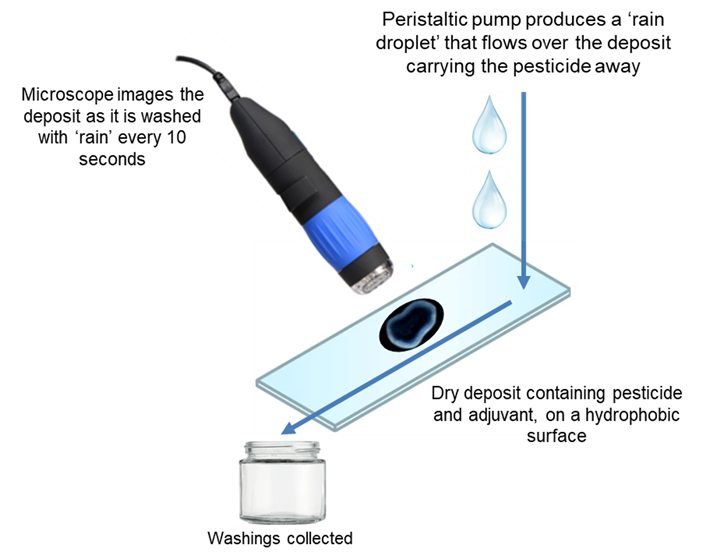
Figure 1: Croda's rainfastness screening method
By plotting the time against the remaining deposit, we can observe the relative rainfastness performance at each time point and compare the properties of different additives and formulations. Figure 2 shows an example of the type of data generated from this, comparing a control (a contact herbicide, phenmedipham) with no rainfastness additive to one with a development rainfastness material.
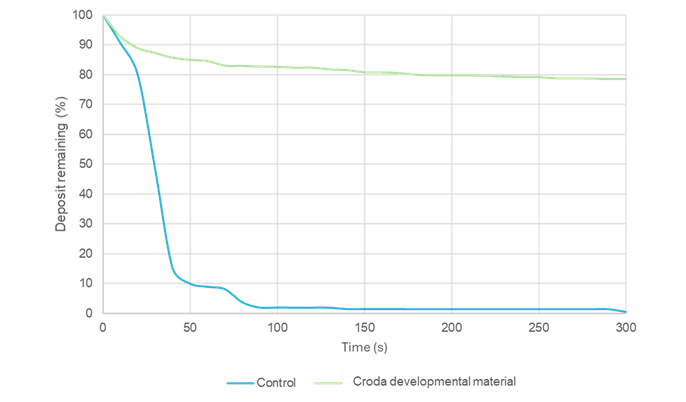
Figure 2: Example of rainfastness data using glass slide screening method
The limitation of this method is that it trades many of the real-world variables for more easily controlled ones in order to boost speed and repeatability. This includes factors such as swapping from leaves to synthetic slides, spray nozzles for a pipette, and variable rain for a more consistent pump.
This allows for excellent consistency but means the test needs to partner with a more authentic one to get a complete picture of product performance. For us, the partner method is one carried out by our glasshouse team; formulations are sprayed using commercial spray equipment onto representative target plant species and the overall formulation efficacy is evaluated directly.
Short of full-scale field trials, direct glasshouse evaluation is one of the best ways of evaluating the performance of any adjuvant, with much easier control of conditions for consistent results. Analysis techniques vary by species and active MoA, but plant weight, visual assessment and/or photosynthetic efficiency measurements are all potential options.
Figure 3 shows data obtained using a terbuthylazine (herbicide) formulation applied to Ipomoea purpurea plants (common morning glory, the same family as bindweed) and evaluated by measuring photosynthetic efficiency. The test compared the same herbicide formulation with and without a developmental rainfastness additive to a treatment with no herbicide.
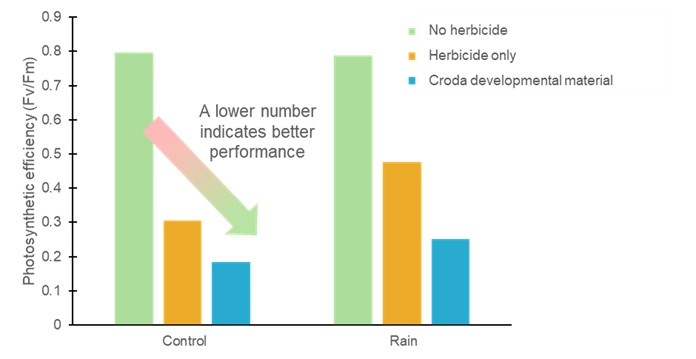
Figure 3: Data generated using glasshouse method comparing performance with & without a rainfastness adjuvant and rain event
The same test protocol was carried out on samples with and without a rain event to compare efficacy. It is important to note that the measurements indicate plant health, so for this herbicide test, a lower bar indicates better performance as less active ingredient has been washed away by the rain event.
Our focus
Using methods like those described, we have been running a programme of study assessing the enhancement of rainfastness across a wide range of actives. Most recently, the upcoming European synthetic polymer microparticle regulations (often referred to as a ‘microplastics ban’) have reduced the available sticker chemistries substantially, resulting in an upcoming unmet need for the industry.
In response to this, a wide variety of chemistries have been evaluated, looking for compliant materials that will still deliver the required performance. These efforts have looked at a range of options, including boosting the biodegradability of existing materials, functionalising film-formers from the existing range, and evaluating materials from other markets that could deliver the right properties to agricultural formulations.
For Croda, the most interesting chemistry being worked on is a class called alkyd resins, a staple in the paints and coatings industry that has so far not seen wide usage in the agricultural industry. The resins are polyesters, which can be 100% biobased, with the typical components being readily available polyols, dicarboxylic acids, and fatty acids. Varying the components and their proportions enables tuning of key polymer physical and chemical properties that affect film formation.
Alkyd chemistry can be delivered as an oil-in-water emulsion system and, therefore be readily included into aqueous systems or added directly to the tank before spraying as a stand-alone adjuvant. This delivery system is then able to provide rain-resistant films to surfaces from aqueous dilutions in a spray tank; thereby affording a solution to the challenge of providing rain-resistance (which often necessitates hydrophobic ingredients) from water-based systems such as suspension concentrates.
This class can be tuned for optimal formulating and rainfastness properties, while being made up of all liquid components to conform to upcoming microparticle legislation.
Conclusion
Rainfastness adjuvants play a vital role in agriculture, helping protect pesticide performance even after rainfall or irrigation. ‘Sticker’ adjuvants are now under increased scrutiny, as upcoming EU microplastic regulations are likely to limit the commercial use of many existing products.
In response, we are intensifying our search for alternative, sustainable technologies that meet regulatory expectations while continuing to deliver market-led innovation.
This article is featured in Speciality Chemicals Magazine Jan/Feb 2026.
Contact us to find out more about rainfastness and our adjuvant portfolio.
The future of innovative ingredients in Agriculture

Product finder