Concentrated aqueous emulsion (EW)
In the agrochemical industry, concentrated aqueous emulsion (EW) formulations are stable emulsions of water insoluble organic liquid in a continuous water phase. They can be considered as a safer and more environmentally friendly alternative to emulsifiable concentrates (EC). In an EW, the continuous phase is water-based (as opposed to an organic, often petroleum-based solvent for ECs), which offers the benefit of lower phytotoxicity, no flashpoint concern, ease of handling, and a lower environmental impact.
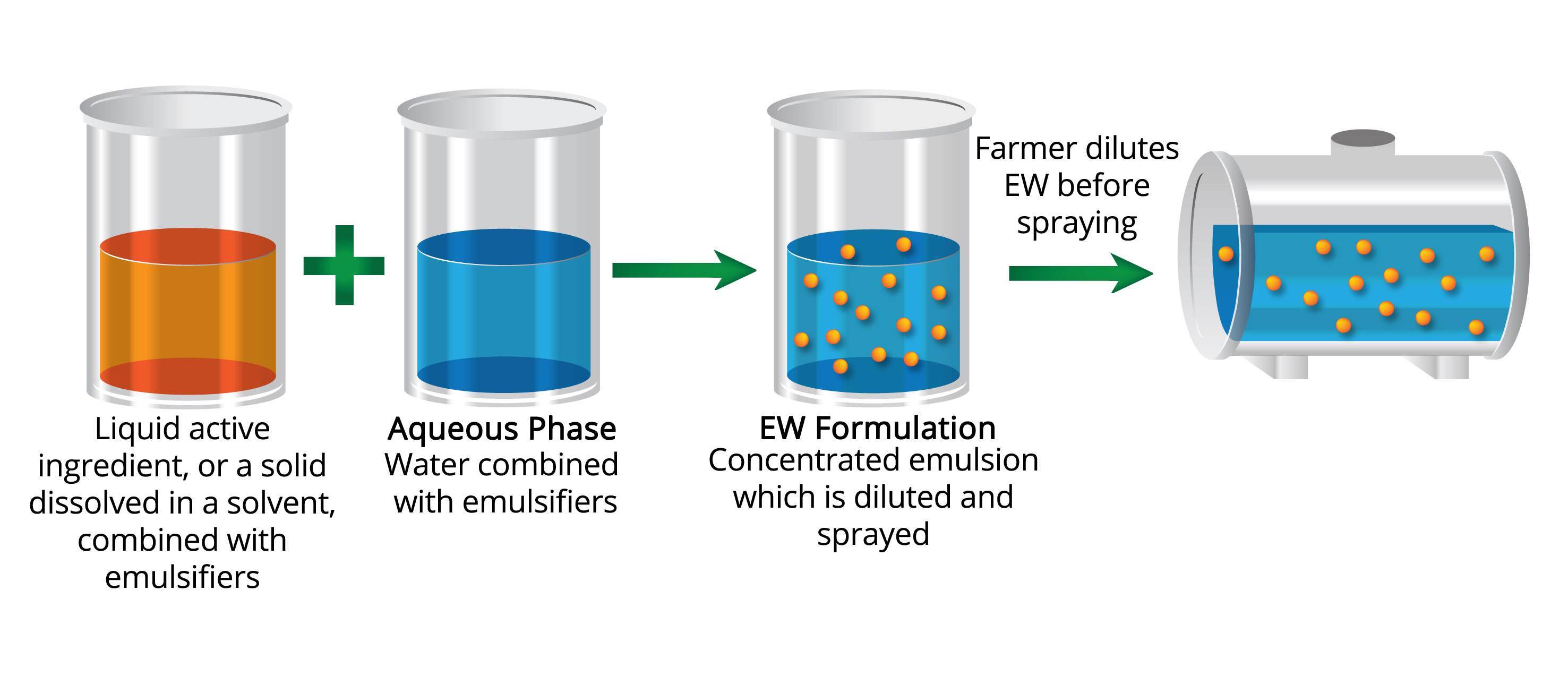
EW formulations are physically stabilised by specifically identified polymeric surfactants incorporated at an appropriate level. The emulsion has already been established in the formulation and is only diluted further in the spray mixture. These formulations can sometimes contain a co-solvent, inert ingredients, and co-formulants to ensure stability, enhance end-use performance, and support content uniformity during storage and application.
Benefits
- Simple to manufacture
- Relatively high biological activity
- Good chemical stability
- Spontaneous emulsification upon dilution
Limitations
- Use expensive solvents containing harmful VOCs
- Solvents may affect plastics and rubbers in spray applicators
- Active ingredients needs to be fully soluble in the solvent over a range of temperatures
- Use of water miscible solvents can cause active ingredient crystallisation (i.e., crystal growth) problems upon dilution
The Formulator's Toolbox (Full Version)
Products recommended for EW
We recommend the combination of a low and high HLB polymeric surfactant to obtain EW formulations with excellent, long term stability. This surfactant combination ensures that the formulation maintains stability over a range of application temperatures.
.jpg&mn=cropcare&w=768&xr=0&yr=0&xfp=6&yfp=6&hash=2DB72ABD5AB1ECC294B3ADDE82DCB7F919C138999FEC74AA)
Atlas™ G-5004 LD
.jpg&mn=cropcare&w=768&xr=0&yr=0&xfp=6&yfp=6&hash=48717E6EA80954ABD146F117F2CAC16E19C138999FEC74AA)
Atlas™ G-5002L
.jpg&mn=cropcare&w=768&xr=0&yr=0&xfp=6&yfp=6&hash=20085CA4656E3D1606EFFB22F3D81A0819C138999FEC74AA)
Atlas™ G-5000

Tween™ 22
Tween™ 23
We recommend the combination of a low and high HLB polymeric surfactant to obtain EW formulations with excellent, long term stability. This surfactant combination ensures that the formulation maintains stability over a range of application temperatures.
Atlox™ 4916

Atlox™ 4914
In an EW formulation the active ingredient must be fully soluble in the carrier solvent. If the active ingredient is solid, it will need to be dissolved in a solvent. Croda’s Seatons Natural Oil range are 100% natural and renewable, which make them a great choice for use in crop care formulations.
.jpg&mn=cropcare&w=768&xr=0&yr=0&xfp=6&yfp=6&hash=BB9E08CCA29C7EA9890679CCAB89BACB19C138999FEC74AA)
Seatons refined linseed oil

Seatons refined rapeseed oil
If an EW is not properly structured, the formulation can breakdown resulting in the oil phase creaming to the surface. This leads to reduced shelf life stability and poor performance in the field. The inclusion of a rheology modifier helps overcome this issue by increasing the viscosity of the formulation, providing improved stability.

Atlox Rheostrux™ 300A

Formulation finder