From living systems to defined actives: how Croda enables the next phase of biologicals
On one side, there is a strong push toward Regenerative Agriculture, where living microorganisms gain strategic relevance as tools to build healthier soils and more resilient production systems. On the other side, there is a rapid expansion of downstream capabilities to provide microbial metabolites as the next generation of biological active ingredients, often positioned and used in ways that resemble conventional chemical actives.
What matters commercially and technically is that these two movements demand different performance attributes, and they create different formulation and scale-up challenges. The good news is that Croda is uniquely positioned to support customers in either direction, from bioprocess optimisation to robust formulation and delivery technologies, as Croda’s capabilities span the full journey from upstream production to downstream stabilisation and final product performance.

The Regenerative Agriculture push: when living microorganisms create more value
In Regenerative Agriculture, the guiding principle is a soil health first approach. Many programmes focus on fostering native soil microbiomes through practices such as increasing organic matter inputs, using cover crops, reducing tillage, diversifying rotations, and minimising the use of harsh chemicals when possible.
These practices tend to improve soil structure and biological function over time, increasing microbial biomass, functional diversity, and overall system stability. Within this context, applied living microbes are increasingly used as targeted interventions, not necessarily as a replacement for the native microbiome but to introduce specific functions when there is an agronomic gap, low abundance, or a need for a faster response. Examples include:
-
Inoculants and nutrient-mobilising microorganisms (e.g., Rhizobium, Azospirillum, and phosphate solubilisers), together with biostimulants, to enhance nutrient acquisition and modulate plant physiological responses,
-
Biopesticides (e.g., Bacillus, Trichoderma) to contribute to disease suppression and plant resilience; and
-
Microbial consortia engineered or curated to deliver broader functionality than a single strain.
A key value proposition of this scenario is that fostering native microbiomes builds resilience, while applied microbes deliver targeted functionality. However, the main challenge remains: achieving consistent performance across variable environments.
Soil type, climate, agronomic practice, chemistry programmes, and native microbial community composition can strongly influence outcomes. That is why many regenerative programmes increasingly emphasise monitoring and decision support (including advanced approaches such as microbiome profiling) to connect biological interventions to measurable improvements in soil function and crop response.
Biological formulation development challenges and how Croda enables solutions across the value chain
As a global supplier of speciality ingredients and delivery technologies for the crop protection and seed enhancement industries, Croda Agriculture’s mission is to enable the agricultural community to improve yields and contribute to global food security through innovative, bio-based, and low-carbon solutions.
We work with biological formulators at every stage of development, from initial strain evaluation through stability testing and scale-up, understanding that success hinges on navigating formulation complexity across the value chain. This positions us to address the key bottlenecks that continue to limit successful commercialisation:
-
The discovery and selection of new strains with consistent, repeatable field performance remain key industry challenges. Croda enables this process through a compatible and versatile formulation portfolio for biologicals, suitable even for sensitive microbial strains.
-
Scale-up remains a key challenge, particularly for organisms with complex growth behaviour. Liquid fungal processes, for example, can be intrinsically difficult to scale consistently. Croda supports customers through a dedicated portfolio designed to address common bioprocess challenges during scale-up, enabling higher yield and concentration in liquid fungal systems, while also providing formulation strategies to preserve product viability and performance over time.
-
Formulation design is critical to protect microbial viability and functionality across storage, transport, and real-world handling conditions. Croda supports these needs through a versatile formulation portfolio, spanning cost-effective solutions, formulation chassis, and advanced technologies for more complex systems. Built on robust manufacturing processes, Croda’s ingredients are designed to minimise impurities and eliminate toxic byproducts, ensuring compatibility, stability, and sustained performance throughout the product shelf life.
-
Shelf-life and stability become even more demanding for multi-strain products. While these systems can deliver broader performance, they introduce additional formulation constraints, particularly when combining bacteria and fungi. Differences in biological requirements, such as sensitivity to water activity and formulation microenvironments, can compromise viability if not carefully managed. In practical terms, microbial consortia force the industry to treat formulation not as a finishing step but as a core technology that determines whether a product can be reliably manufactured, stored, transported, and applied.
-
Performance of chem-bio technologies. A growing trend in Regenerative Agriculture is the development of chem-bio formulations, combining biological and chemical actives within a single product. Croda enables this approach through advanced formulation technologies that ensure compatibility, preserving microbial viability while maintaining chemical performance. This trend is accelerating as the industry seeks to reconcile productivity and sustainability goals while simplifying application and delivering more consistent field performance.
The downstream shift toward defined bioactives: chemical-like performance with new expectations and familiar risks
Running in parallel, a second structural shift is underway: some biologicals players are investing in downstream processing to obtain pools of metabolites (sometimes intentionally not purified to a single component, either to optimise cost or preserve synergy among bioactive components) and/or purified bioactive compounds, including metabolites, peptides and RNAi-based technologies (e.g., dsRNA), that can be used as is or further functionalised to enhance potency, stability or field performance.
This approach often enables a final product that can be positioned more like a conventional active ingredient: a clear dose response, a more standardised composition, and a stronger expectation of consistency across crops and environments. For many companies, this is a strategic bridge between the biologicals' promise and the operational predictability of chemical portfolios.
However, this scenario also inherits a well-known limitation: resistance risk. When metabolite-based products behave more like single-mode actives, the market can raise the same critique that exists for conventional chemistry: selection pressure can increase, and resistance management becomes essential. This has become a recurring discussion point when customers debate whether metabolites represent a fully new paradigm or a biologically sourced version of the same structural challenge seen in chemical actives.
How surfactants enable performance throughout bioprocess and formulation
A critical (and sometimes underestimated) enabler of metabolite-based strategies is the smart use of surfactants and functional ingredients across the entire value chain. From the early stages of bioprocessing, where microbial cells are most sensitive, Croda offers technologies specifically designed to be compatible with living cells during fermentation, minimising the presence of impurities and toxic byproducts that can negatively impact cell viability, metabolic efficiency, and overall process performance. This level of control is key to enabling consistent scale-up and maximising yield.
Beyond fermentation, Croda continues to support downstream processing and final formulation through a comprehensive and versatile portfolio, ensuring stability, compatibility, and performance of the final product. By combining smart ingredients with deep application expertise, Croda provides solutions that span the entire value chain, from bioprocess optimisation to final formulation, enabling customers to develop robust, high-performing biological products.
This support translates into tangible benefits across both upstream and downstream stages. During bioprocessing (upstream/fermentation), this includes
-
(i) enhancing process robustness by addressing common scale-up challenges (such as mass transfer limitations, mixing constraints, foam management when relevant, controlled cell lysis, and overall process stability);
-
(ii) enabling improved process consistency and potentially higher productivity (yield); and
-
(iii) supporting metabolite stability within the production environment, reducing risks that could compromise scale-up performance.
During downstream processing and formulation, surfactants play a critical role in maintaining metabolite stability and ensuring effective delivery in the final product. They also support key physicochemical attributes required for real-world use, including handling, compatibility, dispersion, stability, and application performance, bridging the gap between “what the molecule can do” and “what the product consistently delivers” under field conditions.
Importantly, as the agriculture biologicals market matures, ingredient quality is becoming a critical differentiator. In microbial systems, the presence of impurities and byproducts in formulation components can directly impact microbial viability and stability. As a result, consistent and well-controlled inputs are not only a matter of compliance but also a key performance lever.
From trial to system: integrating biologicals in modern agriculture with Croda-enabled performance
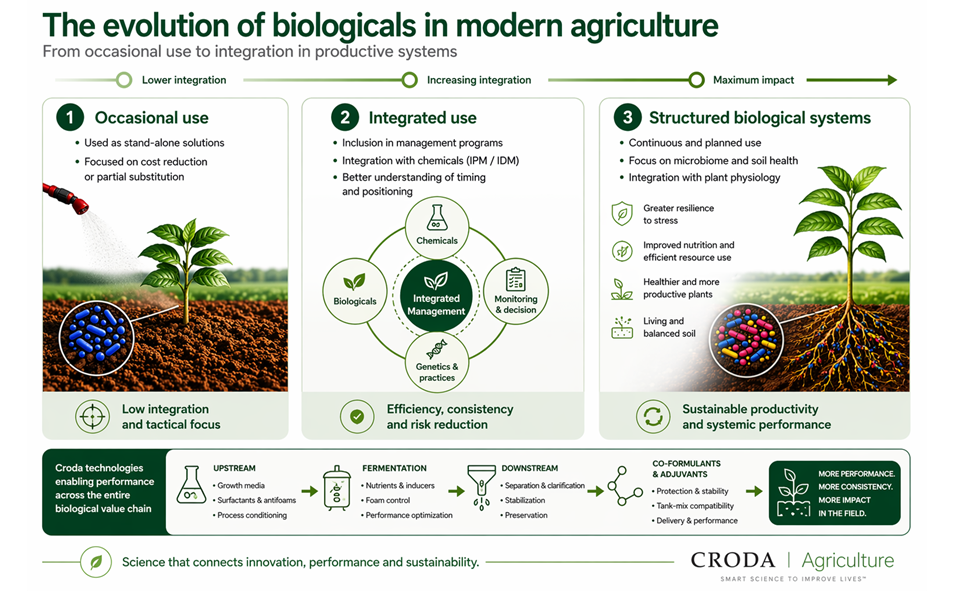
Figure 1. Biologicals adoption in agriculture, illustrating the transition from occasional use to integrated programmes and structured biological systems. The framework reflects increasing levels of agronomic integration, complexity, and performance requirements, spanning living microbial solutions, defined bioactives (including metabolites and RNAi), and chem-bio approaches. [illustration based on SLC Group’s diagram presented at Biosummit (Brazil 2026)]
From the above illustration, we see that adoption is not necessarily linear; farms may operate across stages simultaneously or choose distinct end-states depending on crop systems, economics, and risk tolerance. Across all stages, Croda enables reliable performance through technologies that support the full value chain, from upstream bioprocessing to downstream formulation and delivery.
- Occasional use: Biological products are applied in a standalone manner, often focused on cost reduction, trialling, or targeted substitution in a limited number of use cases. At this stage, living microbes are typically used as single-strain solutions (e.g., inoculants or biopesticides) in well-defined scenarios, while consortia are less common because of higher formulation and handling demands.
Defined bioactives, such as metabolites and, in selected cases, RNAi-based technologies, may also appear here when positioned as “drop-in” tools with clearer dose-response and simpler operational fit. Chem-bio approaches can begin as pragmatic pilots, either via co-application or early co-formulations, provided compatibility and microbial viability are preserved through appropriate formulation design.
- Integrated use: Biologicals become embedded within crop management programmes, often alongside conventional chemistry (e.g., Integrated Pest Management), to improve positioning, coverage, and consistency. Here, living microbes and emerging consortia are deployed more systematically, but success increasingly depends on operational practicality, especially tank-mix biocompatibility, integration into existing spray programmes, and reliable field performance. In parallel, metabolite-based actives often map naturally into this stage because they can be positioned and deployed similarly to conventional actives, supporting predictable dose-response and facilitating adoption within established programmes.
RNAi technologies also fit strongly within integrated use when delivery, coverage, and application conditions are managed effectively, reinforcing the broader shift toward precision-enabled biological performance. At this stage, chem-bio strategies become a major enabler, either through co-applications or designed co-formulations that combine biological and chemical modes of action while maintaining performance on both sides.
- Structured biological systems (emerging trend): Biologicals are used continuously and strategically as part of a broader agronomic system, with a stronger focus on soil functionality, microbial ecology, plant physiology, and technology-enabled decision-making. In this stage, living microbes and consortia are often leveraged as system tools, supporting resilience, functional diversity, and targeted agronomic outcomes across seasons, while formulation and shelf-life requirements become increasingly demanding.
Defined bioactives, including metabolites and RNAi-based technologies, can play a complementary role by enabling more targeted, “active-like” performance within structured programmes, where timing, delivery, and resistance management are deliberately planned. Chem-bio approaches evolve beyond operational convenience into intentional agronomic design, supporting resistance management, system-level performance optimisation, and more precise integration of biological and chemical modes of action.
Where Croda enables performance
Across all stages, performance increasingly hinges on execution: compatibility, stability, delivery, and real-world usability.
Croda’s role is to enable reliable outcomes across the full value chain, supporting bioprocess and formulation requirements for living microbes and consortia, ensuring stability and delivery of defined bioactives (including metabolites and RNAi), and providing tank-mix-compatible adjuvant strategies that make chem-bio approaches practical in real-world farm programmes.
Ultimately, this reduces the gap between “what the technology can do” and “what the product consistently delivers” in real farm programmes.
Conclusion
As the biologicals market evolves, success will depend on the ability to translate biological complexity into consistent, scalable, and high-performing solutions. Whether through living microbial systems or defined bioactives such as metabolites and RNAi, performance is ultimately shaped by how effectively products are designed, produced, and delivered across the value chain.
At the core of this transformation, ingredient quality, formulation science, and bioprocess expertise become critical enablers. Croda combines these capabilities to support customers from fermentation to the field, helping to bridge the gap between biological potential and real-world performance and enabling more reliable, scalable, and competitive biological solutions.
These are challenges our team navigates every day alongside formulators — and the right starting point is always your specific microbe, application, and development constraints.
Our team understands the complexity of moving from lab success to field-proven performance. Whether you're navigating strain selection, scale-up constraints, stability challenges, or chem-bio compatibility, we're here to discuss your specific microbe, application, and development needs.
Get in touch with us to explore how we can support your formulation journey.
*This article is featured in June/July 2026 issue of New AG International.
Maintaining microbial viability with high quality surfactants in biological formulations

What is Regenerative Agriculture: A primer

The innovations helping to deliver Regenerative Agriculture
Your partner for microbial formulations

