The rise of chassis systems in oil dispersion development: innovation or illusion?
As demand grows for faster, more efficient oil dispersion (OD) formulation development, chassis systems are increasingly entering the agricultural market. These systems contain the key components of a formulation, meaning only a few other ingredients are required to complete the final product. Marketed as easy-to-use with reliable performance, chassis systems are designed to reduce technical risk, thereby enabling a streamlined path from concept to commercialisation and accelerating agrochemical formulation development timelines.
Yet the key question remains: are OD chassis systems a viable solution given the variability and performance demands of modern agrochemical formulations – or do they risk being an attractive theory that falters in application?
This article explores the factors driving the adoption of the OD chassis and provides a critical perspective on their real-world feasibility.

Overview of OD formulations
OD formulations are inherently non-aqueous systems, with an oil continuous phase representing the largest proportion of the formulation in the concentrate. Since active ingredients are dispersed throughout the oil continuous phase, achieving a physically stable, high-performing and efficacious product requires the use of the correct emulsifiers and dispersing agents at the right inclusion level. These components are essential to maintain uniform dispersion, supporting emulsion stability upon dilution and ensuring compatibility with a wide range of active substances. Pesticide OD formulations are inherently complex, with Table 1 outlining the general composition required to achieve optimal formulation stability, handling and field performance.
| Ingredient | Function |
Dosage (%) |
| Active ingredient | Provides pesticidal effect - often inherently hydrophobic or water-sensitive |
2-50 |
| Oil | Continuous phase, acting as the carrier medium which can also enhance penetration and rain-fastness |
20-80 |
| Emulsifiers |
Non-ionic, oil-soluble surfactants that emulsifies the oil phase on dilution in water | 5-30 |
| Dispersing agents |
Helps to keep the fine solid particles in a dispersed phase in oil as well as water medium. A single or a combination of anionic and non-ionic dispersing agents may be used |
2-20 |
| Rheology modifiers |
Prevent settling and maintain viscosity | 0-5 |
| Other additives (optional) |
Examples include UV protection, drift control agents, and adjuvants |
0-5 |
Table 1: General composition of an oil dispersion formulation
Choosing the right oil phase and surfactant system—including emulsifiers and dispersing agents—is critical for developing a stable and efficient OD formulation. This selection process is often challenging, as formulators must first identify the appropriate oil continuous phase, before evaluating surfactants through detailed performance and stability studies. The initial goal is to achieve a high-performing and stable four-component system but arriving at the right combination is both technically complex and operationally demanding. Phase separation, sedimentation or caking during storage and creaming on dilution in hard water are among the most common OD formulation stability challenges, directly associated with inadequate emulsifier or dispersant performance. Beyond these technical challenges, maintaining consistent inventory quality adds another layer of complexity. Variations in oil sources and quality can also significantly affect formulation behavior, requiring formulators to constantly monitor and adjust. To find out more about the basics of OD formulations, explore Chapter 7: Oil dispersion of our Formulator's Toolbox.
Rise of the OD chassis in agrochemical formulation
In recent years, the agrochemical OD formulation market has seen a rise in OD chassis solutions—precombined oil phases and surfactants designed to ensure consistent quality, reduce formulation effort and help manufacturers differentiate their products. This “all-in-one” single solution approach offered by surfactant manufacturers has quickly gained remarkable traction in the agrochemical industry, with formulators showing tremendous interest in these ready-to-use systems.
Challenges of OD chassis systems
While an OD chassis offers clear advantages, many currently available options fall short when it comes to formulation stability and performance across diverse actives. Some do not perform equally well across different OD recipes, while others require additional dispersing agents to meet stability and performance expectations. An OD chassis can also be limited in their flexibility, and since the oil and surfactant ratios are fixed, only a limited active ingredient loading range may be possible. This may not be the most desirable for some formulators as regions/countries have preferences for certain oil types. Even if the OD chassis performs well and demonstrates strong results, the product’s commercial viability could be influenced by the relative cost efficiency of sourcing individual formulation components separately.
For some active ingredients, OD chassis systems are absolutely a viable option, even if these are only a few occasions. Where chassis systems don’t work it would be necessary to formulate using individual components. Croda has several resources and tools to aid in this development including formulation examples and how-to guides such as our ‘Oil dispersion step-by-step guide’.
Introducing Cresmer™ OD SOL
Recognising the benefits that an OD chassis brings to the market, Croda set out to research how we could overcome the limitations. This led to the development of Cresmer OD SOL, a next-generation, high-performing OD chassis engineered for easy OD formulation.
We believe this system will be successful, as it offers broad compatibility across a wide range of OD formulations and delivers robust agrochemical formulation stability and performance aligned with CIPAC guidelines. It is designed to simplify development, improve formulation consistency and support high efficacy of OD products without the need for additional stabilising components.
Cresmer OD SOL is engineered to simplify the OD formulation development process. It integrates a carefully selected vegetable oil methyl ester with an optimised surfactant system, reducing the number of required formulation components for agrochemical formulators. With Cresmer OD SOL, formulators only need to add the active ingredient and a suitable rheology modifier to complete a fully functional and stable OD formulation.
What makes Cresmer OD SOL effective
The development of this product was targeted for the Asian market with a particular focus on the Indian market. This meant oil selection, active ingredient type/loading levels and compatibility with locally available rheology modifiers could all be tailored to specific regional regulatory requirements and preferences.
Cresmer OD SOL overcomes the formulation flexibility challenges that existing chassis systems have. It has been tested with ten different formulations, demonstrating its flexibility to be used with various active ingredients and at different active use rates. Moreover, since the rheology modifier is not included in the chassis, this means the amount of rheology modifier used can be changed according to the requirements of the formulation.
To add to its flexibility, if an alternative oil is preferred, Cresmer OD SOL is compatible with a wide range of vegetable oil methyl esters (e.g., methyl soyate, methyl oleate and rapeseed methyl ester). This allows formulators to reduce the inclusion level of the product and balance the oil phase with other suitable oils as required.
At present, Cresmer OD SOL is commercially available in the Asian region, with future assessments being made on the viability to other regions. It uses locally sourced materials, keeping the cost in line with market requirements thereby reducing the economic barrier to using this technology.
Performance data of Cresmer OD SOL
Stability testing and performance evaluations conducted on a Penoxsulam 1.02% + Cyhalofop butyl 5.10% OD formulation demonstrated excellent results (Table 3) when formulated with Cresmer OD SOL. Similar superior performance has been consistently observed across most OD formulations developed using this chassis, reaffirming its robustness and versatility.
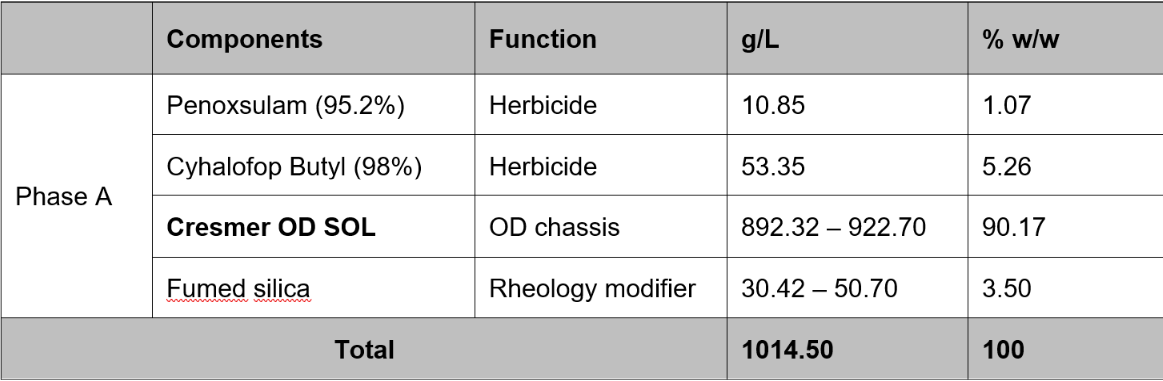
Table 2: Example of a Penoxsulam 1.02% and Cyhalofop butyl 5.10% OD recipe using Cresmer OD SOL
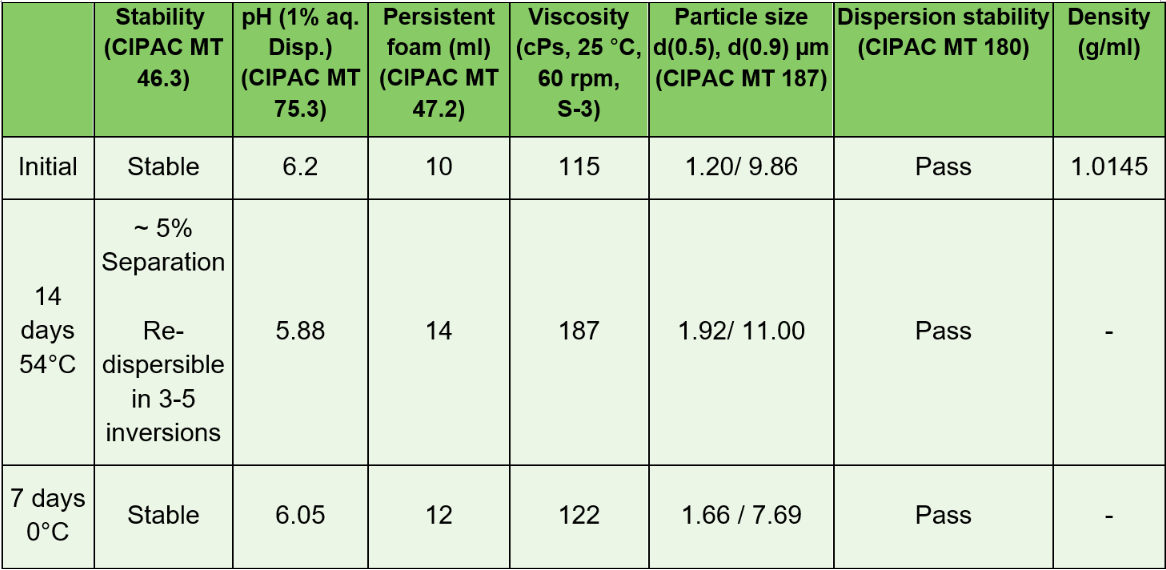
Table 3: Results of stability studies done at low (0 °C) and high temperature (54 °C) for the Penoxsulam 1.02% and Cyhalofop butyl 5.10% OD recipe using Cresmer OD SOL
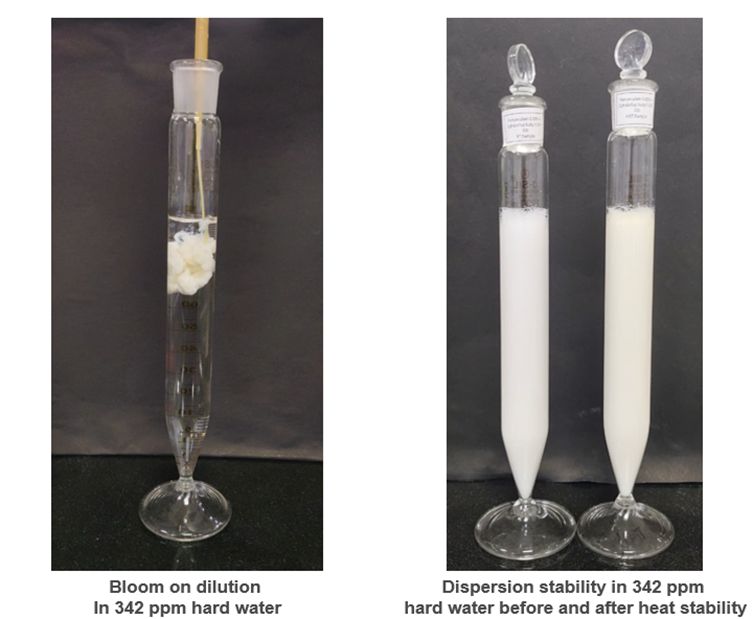
Figure 1: Performance of the Penoxsulam 1.02% and Cyhalofop butyl 5.10% OD recipe using Cresmer OD SOL, demonstrates excellent blooming and dispersion stability on dilution in hard water (342 ppm)
Conclusion
While OD formulations are an attractive crop protection formulation type, they are difficult to formulate due to the complex requirements of the system. This has resulted in the rising demand and increasing adoption of OD chassis systems which can simplify and accelerate agrochemical formulation development timelines. OD chassis has its limitations, with some existing products having narrow active ingredient compatibility and limited flexibility to change surfactant ratios to optimise systems. With this in mind, Croda developed Cresmer OD SOL, an all-in-one OD chassis engineered to deliver stable, high performance OD formulations across a broad range of agrochemical active ingredients, targeted at the Asian market. Its optimised surfactant–oil system ensures consistent emulsification and superior dispersion stability, requiring only the active ingredient and a chosen rheology modifier to complete the formulation. Cresmer OD SOL demonstrates how Croda supports the development and optimisation of OD formulations, tailored to meet regional industry requirements.
Get in touch to explore our differentiated crop protection solutions designed for your specific needs.
This article was featured in AgroNews E-weekly and the 2026 Formulation and Adjuvant Technology magazine.
*Note: Cresmer OD SOL is only available across the APAC region, excluding Australia.

Cresmer™ OD SOL

See Cresmer OD SOL in action: 10 formulation sheets now available

Oil dispersion (OD)


Cresmer OD SOL: More blogs worth reading

Cresmer™ OD SOL: A high‑performance chassis for robust OD formulation