Enabling the next generation of agricultural bioinputs
In this article, I explore two major trends reshaping the biologicals market:
- The growing role of living microbial systems in regenerative agriculture, and
- The move toward more defined bioactives with increasingly chemistry-like performances.
Across both, formulation is emerging as the critical step that turns biological complexity into practical agricultural value.
The agricultural biologicals market is moving into a new phase. Growth continues, and integration into mainstream crop protection systems is becoming more visible year after year. According to AgBioInvestor, global markets for biological crop protection and biostimulants reached approximately USD 2.0 billion and USD 4.0 billion, respectively, in 2024, indicating positive growth even amid challenging agricultural economics.
Despite lower commodity prices, high input costs, and tighter farm profitability, biological products have remained resilient and continue to strengthen their role within sustainable agricultural strategies. This momentum is being supported by regulatory pressure on conventional agrochemicals, the expansion of organic and regenerative agriculture, and growing demand for residue-free production systems.
At the same time, increased competition, portfolio expansion by major crop protection companies, and growing investment in innovation are accelerating the sector's technical evolution. As the market matures, expectations are also shifting. It is no longer enough for these technologies to offer sustainability or novelty. They need to deliver reliable performance under real agricultural conditions.
For formulators, this shift changes the question. The challenge is no longer only about how to include biological ingredients in a product but about how to design systems that actually work in practice, preserving viability, enabling compatibility, and delivering consistent field performance. In this context, formulation becomes a defining step, shaping how both complex living systems and more defined bioactive-based approaches can perform.

Making living systems work: formulation challenges in regenerative agriculture
Biological systems refer to living microorganisms or biologically derived components that interact with the crop, soil, or plant environment to deliver specific agronomic functions, such as nutrient mobilisation, plant stimulation, disease suppression, or stress resilience.
Regenerative agriculture has created strong momentum for biological solutions based on living microorganisms. In these systems, applied microbes are not meant to replace native microbiomes but to complement them by delivering targeted biological functions, from nutrient mobilisation and plant stimulation to disease suppression and greater resilience to stress. These characteristics make microbial biologicals increasingly relevant for supporting soil health, plant resilience, and long-term system productivity.
In agricultural applications, biological systems work by supporting or enhancing natural biological processes, for example, by mobilising nutrients, stimulating plant responses, suppressing disease pressure, or improving resilience under stress conditions.
The industry is also changing how these microorganisms are produced. In fungi, there is a clear movement away from more horizontal, labour-intensive solid-state production systems toward more controlled, bioreactor-based liquid fermentation systems. This shift reduces manual handling, lowers the risk of contamination, improves process control, and creates better conditions for the induction and recovery of relevant metabolites.
However, this transition is far from straightforward. Liquid fungal systems are difficult to control and even harder to formulate. Managing hyphal growth during fermentation remains a key technical challenge, and translating these systems into stable, shelf-ready products is still highly complex.
In practice, most current approaches rely on downstream steps, such as spray drying, to stabilise the product. Yet this step introduces its own technical challenges, particularly in preserving biological functionality while ensuring process efficiency and product stability. Optimising drying conditions and protecting sensitive biological structures are critical to maintaining activity after rehydration. Here, Croda’s formulation and process expertise become especially relevant, supporting drying processes, protecting biological integrity, and enabling more consistent performance after processing.
Beyond this, moving directly from liquid fermentation to fully liquid, shelf-stable formulations remains a significant challenge for the industry. For sensitive systems, stability depends on the ability to engineer the microenvironment around the cell. Gram-negative bacteria, for instance, typically require osmoprotection, membrane stabilisation, and fine metabolic control, while liquid fungal systems require structural medium stabilisation, control of water activity, and balanced metabolic conditions, often complemented by interface protection and antioxidant strategies. This is precisely where formulation shifts from a supporting role to a performance-enabling one.
The task for formulators is not simply to combine ingredients but to build protective and functional environments around highly sensitive cells. In practice, that means selecting components that minimise negative interactions, support viability, and maintain usability throughout storage, dilution, and application. This is also where Croda’s broader expertise becomes relevant, not only through formulation components, but also through delivering in increasingly complex biological systems.
While the biological potential of living systems is clear, translating that potential into consistent field performance and commercially viable shelf life remains challenging. Results can vary significantly depending on soil type, climate, agronomic practices, and the existing microbial community. The physicochemical and biological environment surrounding the microorganism during production, storage, dilution, and application becomes a critical determinant of success, particularly for more sensitive systems such as gram-negative bacteria and liquid-fermented fungi.
From a product development standpoint, complexity increases further as the industry moves toward new species and multi-strain systems, including combinations of liquid-fermented fungi and bacteria designed to deliver broader functionality. This is why formulation strategies become more tailored. What works for a gram-positive bacterial species may be inadequate for a gram-negative system; what supports a solid-state fungal spore may not be sufficient for a liquid-fermented fungal system. Formulators increasingly need to combine traditional formulation tools with cell-protection strategies that preserve viability while maintaining usability, shelf-life, and field performance.
As shown in Figure 1, increasing biological complexity places greater pressure on formulation design, as different microorganisms require distinct microenvironments to remain viable and functional over time. This growing complexity not only intensifies formulation challenges but also reshapes the direction of the industry.
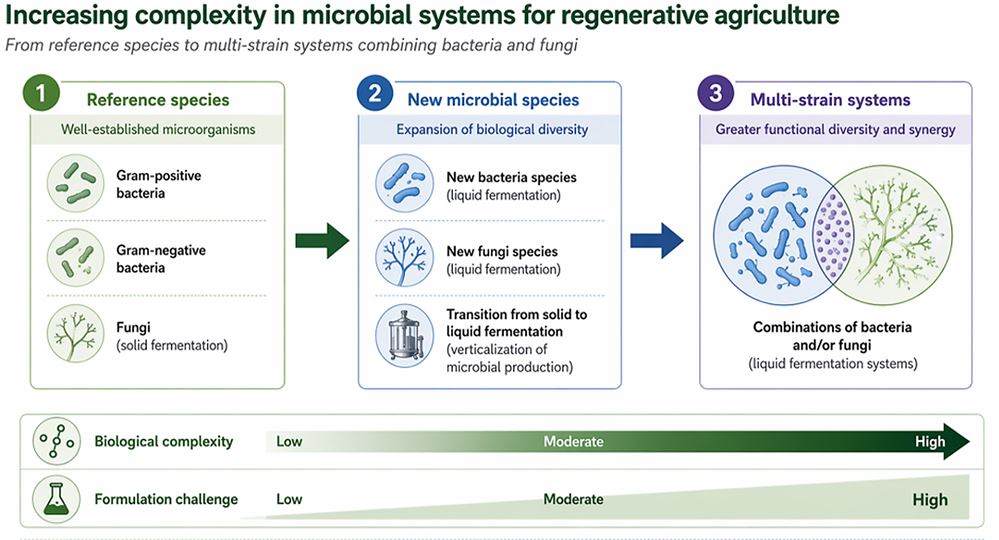
Figure 1: Evolution of microbial solutions in regenerative agriculture, from reference microorganisms to new species and multi-strain systems. This progression also reflects a shift in fungal production, from solid-state fermentation to liquid fermentation in bioreactors. As biological complexity increases, particularly with combinations of bacteria and liquid-fermented fungi, formulation requirements become more demanding, requiring increasingly tailored approaches to ensure viability, stability, and field performance.
As systems become harder to stabilise and predict, there is a parallel trend toward more defined approaches, where performance can be better controlled and understood, bridging biological systems with chemistry-like behaviour.
When biologicals start behaving like chemistry
Running in parallel with the expansion of living microbial systems, a second structural movement is reshaping the direction of the biologicals industry: the trend toward bio-derived active compounds with increasingly defined composition and more predictable performance.
In agricultural biologicals, a bioprocess encompasses the integrated steps used to produce, recover, and prepare biological systems for use, from upstream fermentation and process optimisation through downstream processing and final formulation.
This transition is not binary, but progressive. Many companies are expanding their portfolios beyond formulations based on intact microbial cells toward metabolite-based systems, including partially processed cell contents, filtered broths, and defined pools of bioactive compounds. This emerging class of products represents an important intermediate stage, enabling the use of biologically derived actives while retaining part of the functional complexity and potential synergistic effects of microbial systems. At the same time, it establishes the foundation for future investments in downstream technologies aimed at isolating and purifying specific active molecules.
As illustrated in Figure 2, the industry is progressing through three distinct but connected stages.
- First, products based on living microorganisms remain widely used, particularly within regenerative agriculture, despite well-known challenges related to variability and stability.
- Second, a new wave of metabolite-based products is emerging, where microbial cells are intentionally inactivated through thermal and/or chemical processes and are either retained in the final product or removed through filtration, depending on the formulation strategy.
- Finally, a longer-term direction focuses on more defined systems based on one or a limited number of biologically derived active ingredients.
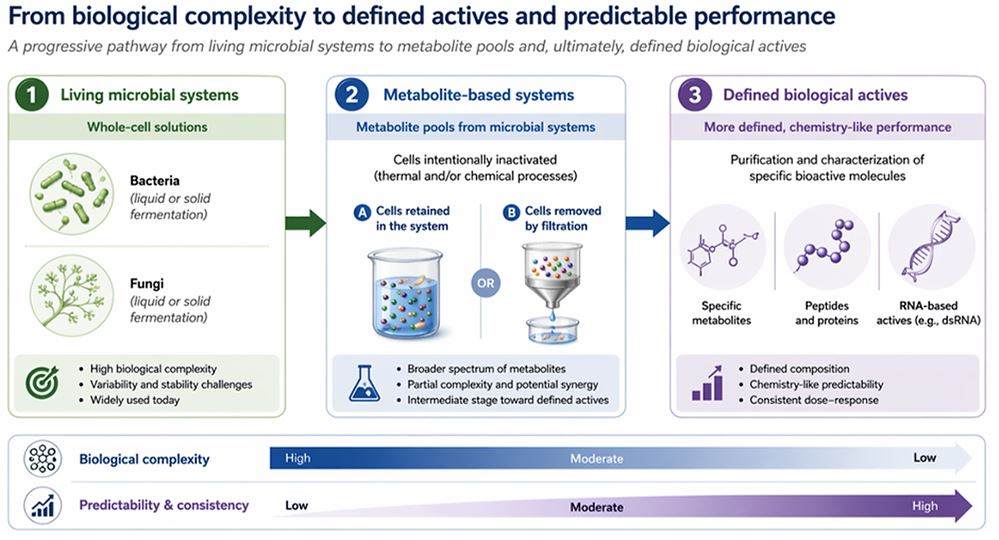
Figure 2: Transition of biological product development from living microbial systems to metabolite-based solutions and more defined active ingredients. This progression includes intermediate stages in which microbial cells are inactivated and either retained or removed, enabling the recovery of bioactive compounds and supporting the shift toward more predictable, chemistry-like performance.
A bioprocess typically includes upstream processing, where biological production is optimised through fermentation and process control; downstream processing, where cells, metabolites, or active fractions are recovered and stabilised; and formulation, where the resulting biological system is transformed into a product that remains usable and effective during storage, dilution, and application.
From bioprocessing and formulation, this transition shifts the challenge rather than removing it. As systems become more defined, the focus moves from preserving live cells to controlling extraction, stability, compatibility, and delivery of active biological fractions. Controlled cell lysis, in particular, becomes a key enabling step. Efficiently releasing intracellular compounds without triggering degradation pathways or secondary reactions is essential to maximise yield while preserving functional integrity.
To address these evolving downstream requirements, Croda provides a portfolio of components that support bioprocess optimisation and controlled metabolite recovery, including technologies for controlled cell lysis that can be used either as an alternative to or in combination with heat-based methods. By facilitating metabolite recovery under controlled conditions, these solutions can help reduce downstream processing steps and improve overall process efficiency.
This trend reflects a clear strategic objective: to combine the innovation potential of biological systems with predictability, dose-response clarity, and consistency typically associated with conventional chemical actives. Enabling this transition requires integrated capabilities across bioprocessing, downstream processing, and formulation, where controlled release of intracellular metabolites, preservation of functional activity, and minimisation of unwanted byproducts become critical to ensuring product quality and performance.
Importantly, this trend does not replace the role of living systems. Instead, it expands the landscape of biological solutions. Highly complex living systems and more defined bioactive-based approaches are expected to coexist, addressing different technical constraints, agronomic requirements, and performance expectations. Together, these parallel directions redefine how biological solutions are developed and applied, placing formulation at the intersection of complexity and control.
Making biological systems perform
The future of agricultural biologicals will not be defined only by the discovery of new actives but by the ability to make them perform reliably under real agricultural conditions. As expectations shift from innovation to delivery, formulation science becomes increasingly central.
For living systems, this means designing formulation environments that preserve viability and functionality. For more defined systems, it means controlling recovery, compatibility, stability, and delivery of the active biological fraction. In both cases, formulation is the step that makes biological innovation usable.
In this increasingly complex landscape, Croda’s role extends beyond supplying formulation components, enabling biological systems to perform consistently across different architectures, technologies, and application conditions. Croda supports the value chain from upstream and fermentation optimisation through to downstream processing, formulation, and delivery, with solutions designed to improve process robustness, support stability, and enable reliable field performance across both living and more defined biological systems.
Companies that can translate biological complexity into practical performance will play a central role in shaping the next generation of biological solutions. By combining formulation expertise with bioprocess capabilities, Croda is well positioned to contribute to this evolution within integrated crop management systems.
Whether you are working with living microorganisms, metabolite-based products or more defined bioactive systems, Croda can support you in turning biological potential into practical performance. Get in touch with our agriculture specialists to explore how we can help optimise stability, compatibility, processing and delivery.
This article is featured in Agropages 2026 Biologicals Special.
Your partner for microbial formulations

White paper: Formulating biologicals for agriculture

White paper: Regenerative Agriculture

